Tokyo University of the Arts ART DX EXPO #3
Da Vinci’s Robot — A Will Dwelling in Shadow
Suguru Goto and the Goto Laboratory present an installation-based music theatre work that brings together contemporary technology and art, using Skeletonics, a large-scale exoskeleton robot suit developed in Japan.
In addition to the performance, workshops will be held, offering audiences insight into the conceptual background and the technologies behind the work.
The piece takes as its point of departure the concept of the “Mechanical Knight” envisioned by Leonardo da Vinci.
Through a stage expression in which body, machine, light, and sound are fully integrated, the work asks how far the human body can be extended.
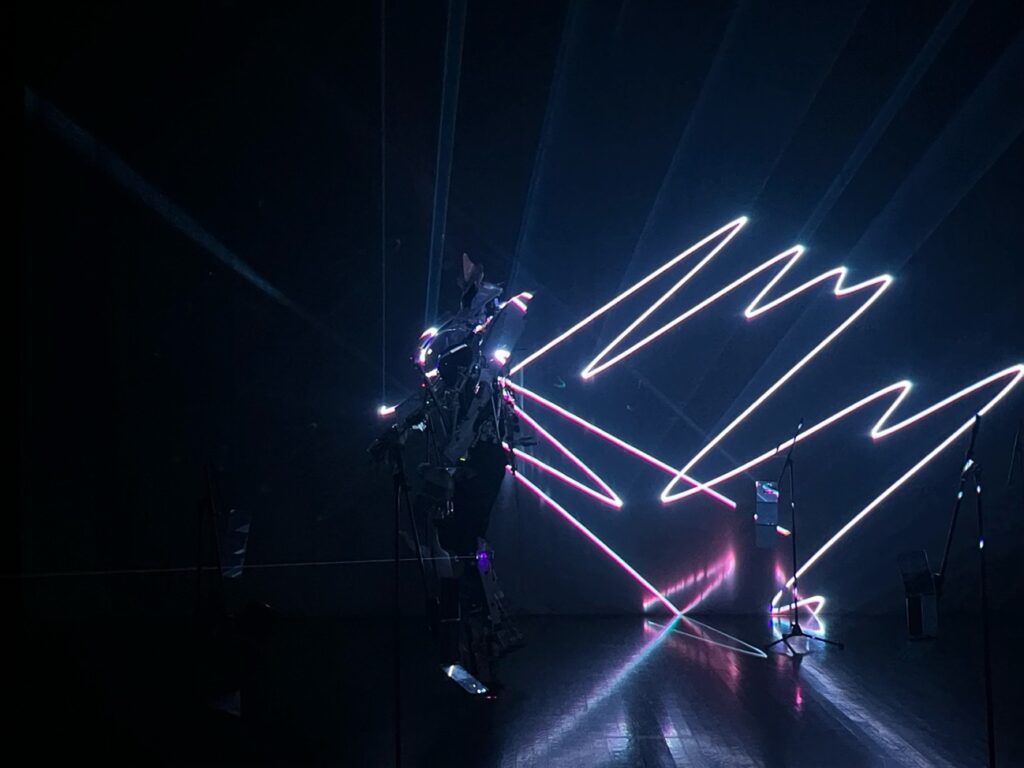
As the massive exoskeleton begins to move, lasers and sound rise into the space, transforming the entire venue into a “theatre of shadows.”
Before each performance, a 30-minute talk and demonstration will be held.
Audiences will be able to experience the movements of Skeletonics up close, along with laser effects and systems for sound and image generation.
A participatory demonstration combining Skeletonics and AI will also take place.
Following this introduction, the main performance will be presented.
When the body moves, sound is born, and light cuts through space.
Human and machine, memory and technology intersect—we invite you to experience this intense, one-of-a-kind live performance at the venue.
Information
■ Title
Da Vinci’s Robot — A Will Dwelling in Shadow
■ Date & Time
Thursday, March 19, 2026
11:00–12:00 / 15:00–16:00
Friday, March 20, 2026 (National Holiday)
12:00–13:00 / 14:00–15:00 / 16:00–17:00
Sunday, March 22, 2026
11:30–12:30 / 13:30–14:30 / 16:00–17:00
■ Venue
Tokyo University of the Arts, Ueno Campus
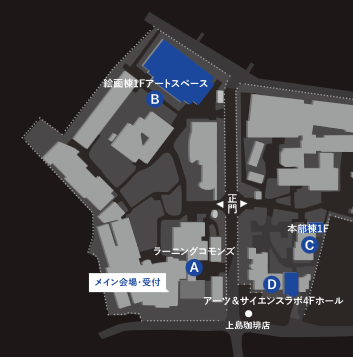
Painting Building 1F, Art Space
■ Information
Credits
・Suguru Goto /Concept, Direction, Composition
・Daichi Akiyama /Laser Technician
・Masato Tanaka / Technical Advisor
・Shengyi Ye / Technical Assistant, Performance
・Yang Zhang / Technical Assistant, Performance
・Linshan Zheng / Technical Assistant
・Qiongyu Li / Technical Assistant
・Haolun Gu / Sound Engineer
・Sen Zhao / Sound Engineer
Just before painting The Last Supper—
a robot secretly created by Leonardo da Vinci,
the “Mechanical Knight,” begins to move once again.
Conceived in 1495, this robot is reborn in 2026, clad in AI and laser technology,
as Skeletonics, a giant exoskeleton from Japan.
Between light and shadow, a hidden will seems to awaken.
This work originates from the historical fact that the Renaissance genius da Vinci actually designed and built a “Mechanical Knight,” and boldly fuses that legacy with contemporary technology and art in the form of an installation-based music theatre.
Around 1495, Da Vinci constructed an automaton modeled after medieval armor, using pulleys and cables to create a “human machine” whose arms, neck, and legs could move.
It was based on an extraordinarily advanced idea: a machine that does not seize power or issue commands, but instead embodies human movement itself.
Strikingly similar to this concept is Skeletonics, a giant exoskeleton robot suit developed in contemporary Japan.
Developed by Robot Ride, Skeletonics is an exoskeleton augmentation suit that amplifies the wearer’s bodily movements through a linkage mechanism and transmits them directly to a “giant body.”
Notably, both da Vinci’s robot and Skeletonics are powered solely by human force.
This structural similarity symbolically reveals how “bodily memory” has been connected to machines across centuries.
On stage, the movements of performers wearing Skeletonics are analyzed in real time through motion tracking, generating sound and light.
The performer’s body weaves a soundscape, while AI, lasers, and projectors are integrally controlled, gradually transforming the entire space into a “theatre of shadows.”
Shadows move before the body itself, narrate memory, and at times intersect and resonate with the shadows of the audience.
The work is conceived as a “Music Theatre” where light and shadow, memory and body, machine and art intersect—
creating a poetic, immersive media art experience that directly engages the audience’s bodily perception.
—An unfinished dream entrusted 500 years ago
now begins to walk once more, before your very eyes
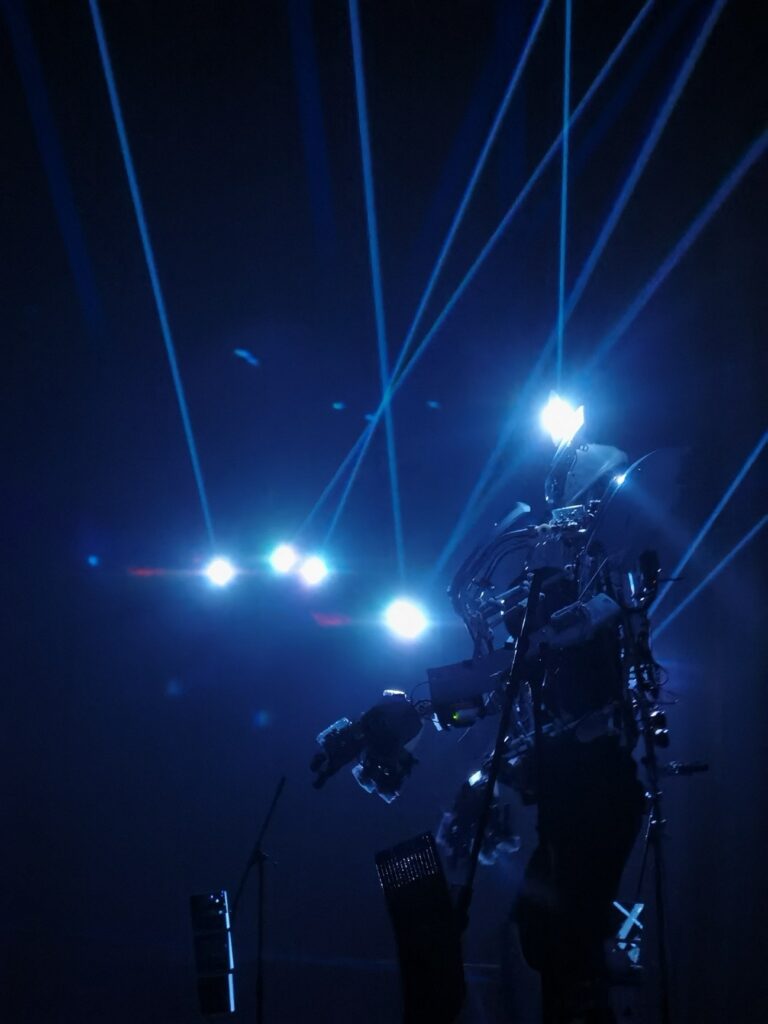
Skeletonics is a large-scale exoskeleton robot suit developed in Japan.
It moves in response to the wearer’s bodily actions, and in synchrony, lasers and sound rise into the surrounding space. When the body moves, light runs and sound is born—everything responds in real time.
The exoskeleton symbolizes the expansion of the body, while the laser represents the expansion of space. Body, sound, and light become inseparable, giving rise to an expanded expressive space that exceeds the scale of the human body. Here, movement itself becomes music, staging, and sculpture.
Using the exoskeleton robot suit Skeletonics, developed by Robot Ride Inc., this work seeks to create a new form of stage expression that fuses performing arts, media art, and digital music. Skeletonics allows a massive body, standing 2.5 to 3 meters tall, to be operated entirely by human power, amplifying the wearer’s movements through its linkage system.
Its overwhelming scale and presence go beyond that of a mere device, bringing to the stage the presence of something that feels almost alive.
At the Goto Laboratory of Tokyo University of the Arts, experiments have been conducted by equipping Skeletonics with motion-tracking sensors and converting bodily movement into sound and images in real time. Combined with AI and laser performance, this research constructs an integrated expressive space in which sound, image, and body continuously influence one another, pursuing new forms of bodily expression through the fusion of human and machine.
By donning a massive machine, the body is extended; by being enveloped in light and sound, space itself begins to tremble. This work addresses not only the viewer’s sight and hearing, but their bodily perception itself, opening up new relationships between humans and machines, expression and technology.
Contact
Art DX Project Office
Tokyo University of the Arts
Email: info_dt@ml.geidai.ac.jp
Venue
Ueno Campus
Tokyo University of the Arts
12-8 Ueno Park, Taito-ku, Tokyo 110-8714, Japan
Access
- JR: 10-minute walk from Ueno Station (Park Exit) or Uguisudani Station
- Tokyo Metro: 15-minute walk from Ueno Station (Ginza Line / Hibiya Line); approx. 10-minute walk from Nezu Station (Chiyoda Line)
- Keisei Line: 15-minute walk from Keisei Ueno Station
- Toei Bus: Ueno Park–Kameido Line (U26); 3-minute walk from Yanaka Bus Stop